Quick Answer
Outdoor cable ties commonly fail because of prolonged UV exposure, incorrect product selection, improper installation and harsh environmental conditions. Selecting cable ties designed for outdoor use and following proper installation practices can improve long-term reliability and reduce maintenance.
Why Outdoor Cable Ties Fail More Often Than Indoor Cable Ties
Outdoor cable ties are exposed to continuous sunlight, changing temperatures, moisture, dust and airborne contaminants throughout their service life. A cable tie that performs reliably indoors may fail prematurely outdoors if it is not selected for these conditions.
Understanding the common causes of failure helps engineers, installers and maintenance teams make better specification decisions and improve long-term cable management reliability.
Common Causes of Cable Tie Failure Outdoors
1. Prolonged UV Exposure
Continuous exposure to sunlight is one of the leading causes of outdoor cable tie failure. Over time, ultraviolet (UV) radiation gradually reduces material flexibility, increasing the likelihood of surface cracking and brittleness. As the material ages, cable ties may also become more prone to breakage during routine maintenance or when subjected to vibration and movement. In many outdoor installations, visible cracking appears only after material deterioration has already progressed for an extended period.
Unlike installation mistakes, UV exposure continues throughout the cable tie’s service life, making it an important consideration when selecting cable ties for outdoor applications.
2. Incorrect Product Selection
Using a cable tie intended for indoor applications in an outdoor environment can lead to premature deterioration. Product selection should always consider the installation environment rather than size or tensile requirements alone.
Selecting a cable tie designed for prolonged outdoor exposure helps reduce premature replacement and maintain cable support throughout the installation’s expected service life.
3. Improper Installation
Incorrect installation can reduce the service life of even a high-quality cable tie.
Common mistakes include:
- Over-tightening
- Applying excessive installation tension
- Using the wrong cable tie size
- Installing cable ties over sharp edges
Following recommended installation practices helps maintain cable bundle integrity and reduces unnecessary stress on the cable tie. Even a high-quality cable tie cannot compensate for poor installation practices.
4. Environmental Conditions
Outdoor cable ties rarely experience a single source of stress. Sunlight, moisture, dust and temperature variation act together throughout the installation, making environmental suitability more important than choosing a cable tie based on dimensions alone
Evaluating the complete installation environment helps improve cable tie performance and long-term reliability.
Why Premature Cable Tie Failure Matters
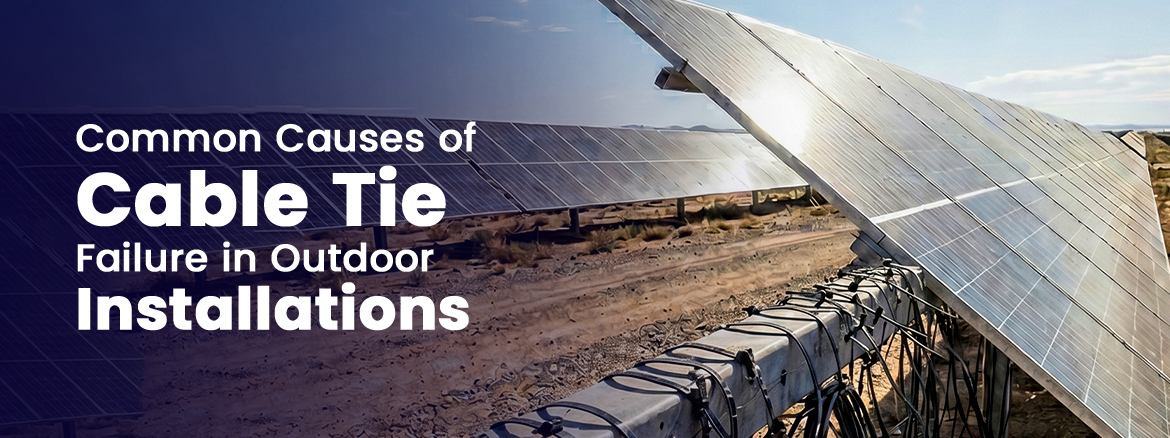
A failed cable tie is more than a maintenance issue. Loose cable bundles can increase inspection requirements, complicate servicing and lead to unnecessary replacement work. In applications such as solar power plants, telecom infrastructure, railway systems and outdoor electrical equipment, cable ties may be exposed to application-specific challenges. Solar power plants, for example, involve continuous UV exposure and high temperatures, making environmental suitability an important consideration during cable-tie selection.
Railway installations can involve prolonged weather exposure and maintenance challenges, so cable-tie selection should consider the installation environment and the practical requirements of inspection and servicing.
Why UV Exposure Requires Special Consideration
Among all outdoor factors, UV exposure is unique because it acts continuously for as long as the cable tie remains in service.
Considering UV resistance during product specification rather than after failures occur can significantly improve long-term cable management reliability, particularly in installations exposed to direct sunlight.
Inspecting Outdoor Cable Ties
Most outdoor cable tie failures show visible signs of deterioration before complete breakage occurs. Routine inspections help identify these early and reduce the risk of unexpected failures.
Look for:
- Surface cracking
- Increased brittleness
- Reduced flexibility
- Visible discolouration
- Damaged locking heads
- Cable ties breaking during maintenance
Replacing deteriorated cable ties early helps maintain reliable cable support and minimise unplanned maintenance.
How to Reduce Premature Cable Tie Failure
Reducing outdoor cable tie failure starts with proper specification and installation.
The following practices can help improve outdoor cable management reliability:
- Select cable ties designed for outdoor applications.
- Match the cable tie size to the cable bundle.
- Avoid excessive installation tension.
- Keep cable ties away from sharp edges where possible.
- Inspect outdoor installations periodically.
- Consider the operating environment before product selection.
Following these practices helps improve long-term performance while reducing maintenance requirements.
Questions to Ask Before Choosing Outdoor Cable Ties
Before selecting a cable tie, consider the following:
- Will the installation be exposed to direct sunlight?
- Is long-term outdoor exposure expected?
- Is the installation expected to remain in service for several years?
- Will maintenance access be difficult?
- Would cable tie failure interrupt operations?
- Does the installation experience harsh environmental conditions?
Answering these questions helps ensure the selected cable tie matches the application’s requirements.
When UV-Resistant Cable Ties Become the Better Choice
When cable ties are expected to remain exposed to direct sunlight for extended periods, UV-resistant cable ties are often the preferred choice. They are specifically designed for outdoor applications where prolonged environmental exposure is an important consideration.
Novoflex UV-Resistant Cable Ties are manufactured from 100% pure virgin UL-listed Nylon 6.6 and incorporate Carbon Black with specialised UV-resistant additives to support outdoor performance.
The product has also been tested for 1,000 hours under a Xenon Arc Lamp by Underwriters Laboratories (UL), which Novoflex states is equivalent to approximately 10 years of outdoor exposure.
Typical applications include:
- Solar power plants
- Telecom infrastructure
- Railway systems
- Power distribution
- Outdoor electrical installations
- Industrial cable management
| Specification | Novoflex UV-Resistant Cable Ties |
|---|---|
| Material | 100% Pure Virgin UL Listed Nylon 6.6 |
| UV Resistance | Carbon Black with specialised UV-resistant additives |
| UV Testing | 1,000 hours Xenon Arc Lamp (UL) |
| Continuous Operating Temperature | -25°C to +85°C |
| Intermittent Operating Temperature | -25°C to +105°C (Up to 500 hours) |
| Flammability | UL94 V-2 |
| Compliance | Halogen Free |
Specifications are based on the published Novoflex UV-Resistant Cable Tie product information.
Choosing the right cable tie depends on the installation environment rather than simply selecting the strongest option.
| Cable Tie Type | Best Suited For | Outdoor Use |
|---|---|---|
| Standard Nylon Cable Ties | Indoor cable management | Limited |
| UV-Resistant Nylon Cable Ties | Outdoor cable management | Recommended for prolonged sunlight exposure |
| Stainless Steel Cable Ties | High-temperature, corrosive and demanding industrial environments | Suitable |
Choosing a Reliable Cable Tie Manufacturer
Choosing a reliable cable tie manufacturer is just as important as selecting the right product. Consistent material quality, controlled manufacturing processes and product testing all contribute to dependable long-term performance, particularly in large infrastructure projects.
Manufacturers with consistent material quality, documented testing and controlled production processes are generally better positioned to support long-term industrial projects.
Since 1980, Novoflex has been manufacturing engineered plastic components for industries including electrical, automotive, railways, renewable energy and industrial infrastructure. With a portfolio of 1,500+ products and certifications including ISO 9001:2015, RoHS, CE and ZED Gold, Novoflex provides cable management solutions for a wide range of industrial applications.
Conclusion
Outdoor cable tie failure is often the result of prolonged UV exposure, incorrect product selection, improper installation and demanding environmental conditions. Understanding these factors helps reduce avoidable maintenance and improve long-term installation reliability.
A cable tie is a small component, but its long-term performance can influence the reliability of an entire cable management system. Selecting the right product at the specification stage helps reduce avoidable maintenance throughout the life of the installation.
The right cable tie is not simply the one that secures a cable bundle today, it is the one designed to perform throughout the environment in which it will operate.
Need UV-resistant cable ties for solar, telecom, railway or outdoor electrical installations?
Novoflex manufactures UV-resistant Nylon 6.6 cable ties tested for demanding outdoor environments. Contact our team for product recommendations, technical specifications or sample requests.