Listen to this blog ...
Quick Answer
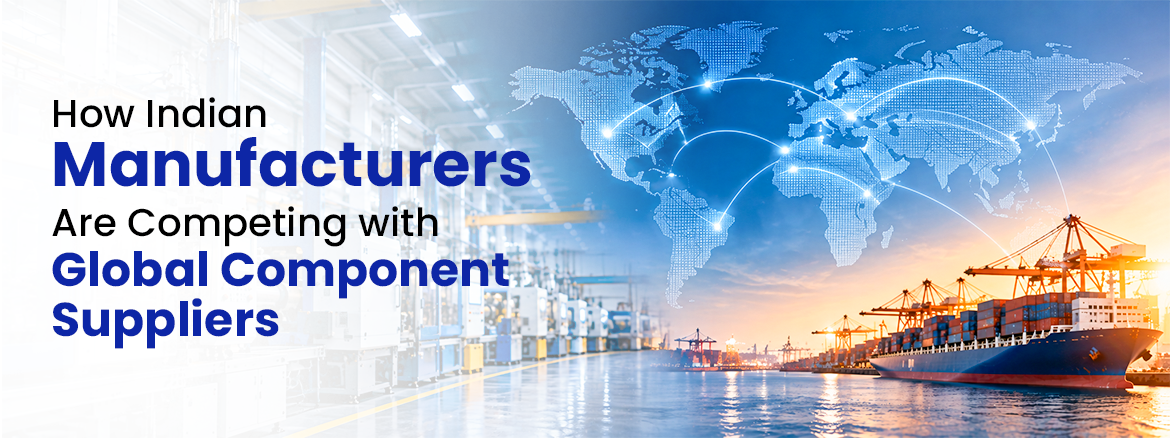
Indian manufacturers are increasingly competing with established global component suppliers by combining manufacturing quality, procurement flexibility, competitive landed costs and responsive lead times. For OEM buyers, the key question is not whether a supplier is Indian or global, but whether it can consistently meet technical, quality and commercial requirements.
For OEMs sourcing industrial components, supplier selection is increasingly based on the complete supply proposition rather than geography alone.
An Indian manufacturer may enter the same sourcing consideration as an established global supplier when it can demonstrate the required manufacturing capability and quality consistency. At the same time, factors such as MOQ flexibility, landed cost and lead time can determine whether that supplier is commercially and operationally viable.
The more useful procurement question is therefore not whether an Indian supplier is cheaper. It is whether the manufacturer can deliver the required quality while improving the overall sourcing equation.
Quality Remains the First Supplier Qualification Test
Price can influence a sourcing decision, but it cannot compensate for inconsistent component quality.
For components used repeatedly across production, OEM procurement and engineering teams need confidence that the approved specification can be reproduced consistently across production batches. This makes manufacturing discipline more important than supplier geography.
When evaluating an Indian component manufacturer, buyers should examine:
- Manufacturing process consistency
- Dimensional consistency
- Material consistency
- Inspection and quality-verification practices
- Process monitoring
- Batch-to-batch repeatability
- Relevant product testing and compliance
- Ability to maintain the approved specification over time
This is relevant across repeat-use industrial components, including fastening, cable management and cable-entry applications, where variation in dimensions, material or fit can affect assembly and downstream production.
For Indian manufacturers competing with established global suppliers, the starting point is therefore not a lower price. It is dependable manufacturing supported by an appropriate quality system.
Looking for consistent fastening and cable management components?
Explore Novoflex’s range of cable ties, wire tie mounts and cable tie mounts for OEM and industrial applications.
[Explore Cable Management Components]
MOQ Flexibility Can Give Procurement More Control
Minimum order quantities affect more than the size of a purchase order. They can influence inventory levels, working capital, storage and replenishment planning.
When a supplier’s minimum quantity does not match actual production requirements, buyers may have to purchase components ahead of demand. That may be acceptable for high-volume programs, but less suitable where requirements vary across products, production cycles or projects.
For this reason, MOQ should be evaluated as part of the supplier’s commercial model.
An Indian manufacturer that can support requirements without a MOQ constraint can give procurement teams greater flexibility to align purchasing with actual demand.
The point is not that every OEM requires low quantities. It is that flexibility has value when the purchasing requirement calls for it.
Need flexibility in component sourcing?
Talk to Novoflex about your component requirement and sourcing quantities.
Landed Cost Matters More Than Unit Price
A lower quoted unit price does not automatically make a sourcing option more economical.
For imported components, the procurement decision can involve additional logistics and sourcing considerations before the component reaches the manufacturing operation. Inventory and replenishment requirements can also influence the overall economics.
A more useful comparison is therefore:
Quoted component cost → sourcing and logistics considerations → landed cost → inventory and replenishment implications
The question for procurement is ultimately:
What is the overall cost of maintaining this component supply reliably?
This is where Indian manufacturing can become commercially competitive. The advantage does not have to come from a lower manufacturing cost alone. A manufacturer can offer a stronger sourcing proposition when its overall supply model produces a competitive landed cost while meeting the required quality.
Lead Time Is a Supply-Chain Consideration
Lead time affects how procurement teams plan component supply and replenishment.
For ongoing OEM programs, the ability to respond to changing requirements can matter as much as the initial delivery. Changes in production volumes, replenishment requirements or component demand can expose weaknesses in a sourcing model with long or inflexible supply cycles.
An Indian manufacturing base can provide an opportunity for a more responsive supply model in relevant markets.
However, lead time remains supplier, product and requirement-specific. The relevant question is not whether domestic supply is automatically faster, but whether the manufacturer can provide a lower and more manageable lead time for the required component and supply arrangement.
This makes lead time part of supplier evaluation rather than simply a logistics metric.
Indian and Global Component Suppliers: What Should OEMs Compare?
The comparison should not treat Indian and global suppliers as two fixed categories. Supplier capability varies within both.
OEM buyers should compare the specific supply propositions against the requirements of the component and production program.
The important distinction is this:
An Indian manufacturer does not become competitive simply because it is Indian. It becomes competitive when its manufacturing and supply model delivers the combination of quality, flexibility, cost and responsiveness that the buyer requires.
That is the basis on which Indian manufacturers can compete within the same sourcing consideration as established global component suppliers.
Evaluating an Indian component manufacturer for your next OEM requirement?
Share your component specification with Novoflex and discuss the appropriate manufacturing and supply option.

What Evidence Should an Indian Manufacturer Provide?
Before qualifying a new manufacturing source, OEM procurement teams should look beyond the initial quotation.
Manufacturing maturity
Manufacturing experience and repeatable processes matter when components are expected to support ongoing production.
Quality management
A structured quality system should support consistent manufacturing and customer requirements. Certifications, compliance marks and product testing should be assessed according to the specific product and application.
Engineering capability
For engineered components, supplier capability extends beyond production. Reviewing specifications, understanding application requirements and assessing manufacturability can be important during development or component changes.
Product capability
A sufficiently broad portfolio can be useful where an OEM has multiple related component requirements.
Supply capability
The supplier should be able to demonstrate that it can maintain consistent production and support the expected supply requirement over time.
These factors provide stronger evidence of supplier suitability than a price comparison alone.
Novoflex: An Indian Manufacturer in the Global Component Supply Landscape
Novoflex, established in 1980, is an Indian B2B manufacturer of engineered fastening, cable management, cable entry and related industrial components. Its production facilities span 25,000 sq. ft. in Kolkata, India, with capacity expansion ongoing, and its portfolio includes 1,500+ engineered components.
For OEM procurement teams, the relevant capabilities are:
*Based on Novoflex’s stated commercial proposition.
Novoflex’s manufacturing approach is built around stable processes, repeatability, tool maintenance, dimensional consistency, inspection and process monitoring, with the objective of maintaining consistency across future production batches.
This is the point that matters in the context of this article: an Indian manufacturer competes with global component suppliers when its manufacturing capability and quality are supported by a commercially viable supply model. For Novoflex, that proposition combines established manufacturing infrastructure and product breadth with the stated advantages of MOQ flexibility, landed cost and lead-time responsiveness.
Explore Novoflex’s engineered component range
From cable ties and cable tie mounts to cable glands, edge clips and circuit board spacers, Novoflex manufactures components for OEM and industrial applications.
What This Means for OEM Component Procurement
When evaluating an Indian manufacturer against an existing global or imported supply source, procurement teams should ask:
- Can the manufacturer consistently meet the required quality?
- Does its MOQ structure fit the actual purchasing requirement?
- What is the comparative landed cost?
- What lead time can it support?
- Can it maintain consistent supply over the required production period?
- Does its product and engineering capability match the application?
This approach keeps the decision focused on supplier capability and total sourcing value, rather than country of origin.
Conclusion
Indian manufacturers are increasingly relevant within component sourcing because competitiveness is no longer determined by unit price or geography alone. Quality remains the qualification baseline, while MOQ flexibility, landed cost and lead time can influence the overall sourcing decision. The right comparison is therefore between complete supply propositions: manufacturing capability, commercial flexibility and supply performance against the OEM’s actual requirements. Novoflex is one example of an Indian manufacturer operating within this broader component supply landscape, with an established manufacturing base, broad engineered-component portfolio and OEM-focused supply approach.