In the era of automation and technology, efficient cable management is now crucial. In a busy server room, a large industrial setup, or even the power distribution network of a commercial building, disorganized cables can cause issues. Inadequate cable management leads to unnecessary repairs, increased downtime, and safety hazards.
Cable tags emerged as an uncomplicated yet highly efficient answer to all of these problems. They make organizations very much possible to go from “not sure” to “accurate” regarding the identification, maintenance, and management of cables.
The Critical Role of Cable Management in Today’s Workspaces
Due to increasing reliance on technology, organizations now handle more cables than before. A data center can have infinitely thousands of data, power, and control cables, while a manufacturing plant could have miles of wiring used to run automation systems and its machines. Without sustainable cable management, disorder can develop in a matter of days.
What poor cable management can result in:
- Longer maintenance cycles with technicians wasting time in search of unknown cables;
- Possibility of accidental disconnections and lower system reliability;
- Danger to safety regarding electrical malfunctioning, fire hazards, or tripping;
- Operational downtime due to troublesome cable identification during problem-solving.
Industries like construction, manufacturing, IT, and telecommunications all truly need to implement a systematic cable identification system with all cable tags.
What Are Cable Tags and How Do They Work?
Cable tags are the identifying and marking devices which, when affixed to conduits or pipes, wires, etc., provide important information about the cable function, destination, circuit ID, installation date, etc. A cable tag can be as simple as a color-coded label or as intricate as one that has been custom-engraved.
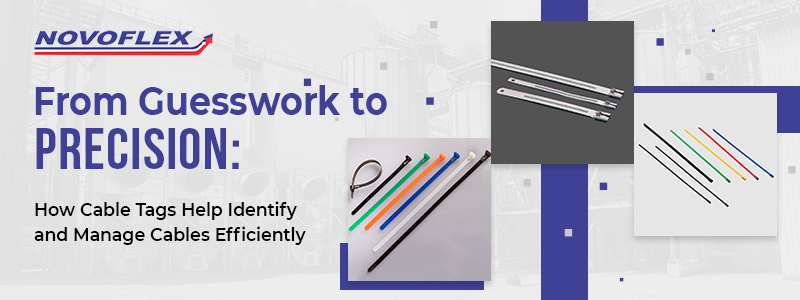
Novoflex offers a wide range of cable tags made from sturdy materials like nylon, PVC, polypropylene, and stainless steel. Each tag is made to withstand harsh environments, including exposure to chemicals, heat, moisture, and ultraviolet light. Cable tags can be classified depending on their usage as follows.
- Tie-on tags: These tags are held onto cables or other surfaces using tie wraps or other fasteners and are ideal for large bundles and applications showing heavy duty.
- Adhesive tags: Quick and easy for application, these are perfect for use indoors, especially for applications requiring flexibility.
- Heat-shrinkable sleeves: These tags are shrinked when heated around the cable and have permanent impenetrable labeling.
- Stainless steel marks: Ideal for hostile environments like offshore platforms or factories that work with corrosive chemicals.
Why Cable Tags Are Essential for Efficient Cable Management
1. Speed and Accuracy in Troubleshooting
One of the key benefits of cable tags is that they minimize downtime. When equipment breaks down or system maintenance is required, technicians need to be able to quickly identify the correct cables. When cables are appropriately labeled, they can take action quickly and without making mistakes.
2. Avoid Costly Errors
In domains where data loss and operational shutdown can arise from randomly unplugging a cable-for example, in server farms and control rooms-unambiguous cable tagging helps dramatically.
3. Improved Installation Procedure
Pre-tagged cables aid the installation of complex projects such as factory automation systems and telecom network setup, thereby speeding and streamlining the work. Technicians can meet project deadlines and avoid confusion by accurately following wiring diagrams or layouts.
4. Professional Appearance and Organization
Cable tags contribute to a cleaner, more professional appearance, especially in settings where customers can see them, such as server rooms, data centers, or control panels. A well-labeled system increases confidence in your infrastructure and makes future upgrades and inspections easier.
5. Compliance with Rules
Many industries are required to comply with stringent safety regulations and standards, such as the National Electrical Code (NEC), OSHA, and ISO standards. And then, by identifying the wires with durable and permanent readable tags, you will also abide by these rules.
6. Economic Benefit in the Long Run:
The tags could come off possibly costing us more upfront, but in the long run, the savings reflected in reduced times for repairs and downtime, and lessening the likelihood of expensive accidents or damage, make up for the slight investment.
Novoflex’s Versatile Range of Cable Tags
Novoflex is aware that the requirements for cable identification vary by industry. Data centers, telecom infrastructure, industrial manufacturing, and energy distribution are just a few of the industries that our cable tagging solutions are designed to work with.Our primary products include:
• Robust tie-on cable tags for demanding environments
• Self-adhesive markers for convenience in offices and commercial buildings; heat-shrink tubing with a permanent labeling design that can be personalized
• Laser-engraved stainless steel tags for harsh conditions
Our cable tags are also available in a variety of sizes, colors, and customization options to meet project-specific requirements.
Why Partner with Novoflex?
From several years of experience in providing high-quality fastening solutions, though, Novoflex is a reputed name in cable management. Some of its benefits in Novoflex cable tags are:
– Material quality which is better for degradation resistance
– Eco-friendly options from recyclable materials
– Custom printing for barcodes, serial numbers, or project-specific code
International industry certifications ensure you follow along with the law and safety regulations.
Conclusion
Cable tags are more than just labels; they are essential elements of a safe, efficient, and well-organized cable management system that allow teams to work with greater clarity, confidence, and intelligence. Designed for maximum performance and durability, Novoflex cable tags are for any cable management application, whether a complex IT network or a large industrial setup.