Quick Answer
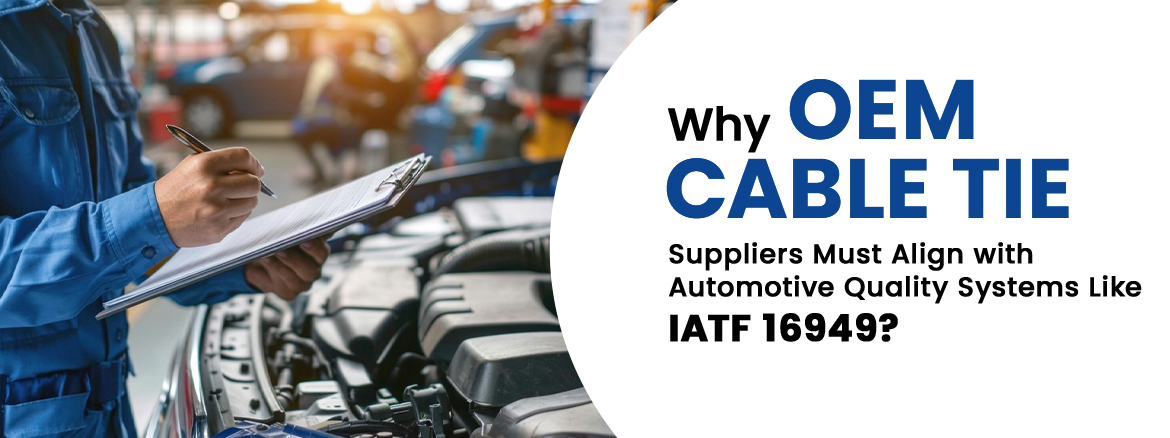
- OEM cable tie suppliers must align with IATF 16949 because it ensures controlled production processes, batch traceability and structured quality systems.
- This alignment reduces supplier risk and supports predictable performance across high-volume automotive production.
Listen to this blog ...
Why Cable Ties Are a Quality-Critical Automotive Component
Cable ties are not treated as simple fastening accessories in automotive systems. They play a direct role in maintaining wiring harness routing, stability and long-term reliability under real operating conditions.
Across vehicle platforms, cable ties are exposed to:
- Continuous vibration during vehicle operation
- Temperature variation across different zones
- Mechanical stress during installation and servicing
- Long-term load conditions
Failures rarely appear as immediate breakage. More often, they emerge as gradual loosening, variation in retention behaviour or differences in installation outcomes across production shifts.
This is why OEMs evaluate cable ties as controlled fastening components, where repeatability across production cycles matters more than isolated performance.
Why IATF 16949 Alignment Is Non-Negotiable for OEM Cable Tie Suppliers?
IATF 16949 reflects manufacturing discipline. It ensures that cable tie suppliers operate with controlled processes, documented traceability and structured change management aligned with automotive supply requirements.
For procurement and quality teams, IATF 16949 is not just a certification. It defines whether a supplier can maintain stability under scaled production conditions.
For automotive OEMs, alignment with IATF 16949 is not optional. It is a baseline requirement to ensure controlled manufacturing behaviour across large-scale supply.
An IATF-aligned cable ties manufacturer is expected to demonstrate:
- Stable production behaviour across batches and shifts
- Documented traceability systems
- Controlled engineering change processes
- Defined processes for handling production deviations
- Process validation beyond initial approval
A supplier may pass initial validation. The difference becomes visible during long-term production.
IATF alignment ensures that production behaviour is system-driven rather than dependent on isolated runs.
How OEMs Evaluate Cable Tie Suppliers Within IATF-Aligned Systems?
Specification sheets define design intent. OEM decisions depend on how reliably that intent is delivered during production within controlled systems.
Manufacturing Stability Across Production Cycles
Dimensional accuracy and locking behaviour must remain stable across batches. Even small variations can affect installation predictability and downstream assembly performance.
OEM teams also evaluate whether production is monitored through process control mechanisms, ensuring variation remains within defined limits rather than relying only on post-production inspection.
This is where experienced cable tie suppliers operating within IATF-aligned systems differentiate themselves from commodity sourcing options.
Batch Traceability
Each production batch should be traceable to raw material input and process conditions. This enables rapid identification and containment if a quality issue arises.
Injection Moulding Discipline
Locking mechanism performance depends on tooling precision and process control. Variations in serration geometry or mould condition directly impact repeatable performance.
This is where process-controlled cable ties manufacturer environments aligned with IATF systems differ from suppliers operating without structured production control.
Material Behaviour Stability
Automotive cable ties are typically manufactured using PA66 (Polyamide 6.6), selected for its thermal and mechanical characteristics.
In controlled systems, this includes nylon 6.6 tested by UL, supported by documented traceability.
Material behaviour must remain stable under temperature variation, vibration and long-term operational conditions.
Change Management Control
Uncontrolled changes in material, tooling or process introduce long-term risk.
A qualified plastic cable tie manufacturer operating under IATF-aligned systems ensures that any modification is documented, validated and communicated.
Failure Patterns When Suppliers Operate Outside IATF Systems?
Most cable tie failures are not visible during inspection. They appear as variations in locking strength, brittleness under temperature changes and inconsistent installation behaviour during production.
Common failure patterns include:
- Variation in locking strength across batches
- Brittleness under temperature variation
- Gradual loosening under vibration
- Installation inconsistency across operators
These issues typically emerge during scaled production or field use rather than initial validation.
When installation behaviour depends on operator force rather than component predictability, assembly control becomes difficult.
Variations in serration geometry can also affect tensioning tool behaviour, reducing installation predictability across operators.
These risks are precisely what IATF 16949 systems are designed to prevent through structured process control and traceability.
The Risk of Non-IATF-Aligned Cable Tie Suppliers
Sourcing from a non-IATF-aligned cable ties manufacturer may reduce initial cost but increase long-term operational risk.
Suppliers operating outside IATF-aligned systems lack the structured controls required to manage variation at scale.
Typical consequences include:
- Revalidation across production plants
- Audit observations during quality checks
- Increased inspection requirements
- Performance variation across locations
At scale, even minor variation can affect thousands of units per production cycle, increasing inspection load and operational friction.
System-Level Evaluation Within IATF-Aligned Supply Ecosystems
OEMs often evaluate fastening systems as a whole rather than individual components.
A supplier capable of supporting both cable ties and mounting solutions within an IATF-aligned system enables:
- Reduced vendor complexity
- Aligned material and process behaviour
- Simplified qualification processes
Working with a cable tie mount manufacturer within the same ecosystem improves compatibility and reduces variation risk.
How Novoflex Aligns with Automotive Quality System Requirements?
With over four decades of manufacturing experience since 1980, Novoflex operates within structured quality management systems aligned with automotive supply expectations.
Novoflex supports supply requirements for leading automotive manufacturers, including Maruti Suzuki, Kia, Tata Motors, JCB, Escorts and more, reflecting alignment with structured quality and production expectations.
As a manufacturer of engineered plastic components, Novoflex supports automotive OEM programs with process-controlled manufacturing systems designed for predictable performance across high-volume production cycles.
The company’s approach focuses on:
- Process-controlled manufacturing
- Documented batch traceability
- Consistent tooling and moulding discipline
- Structured quality systems
Explore applications across automotive environments
Conclusion
Cable ties may be small components, but they function as control elements within automotive systems.
Their performance depends not only on design but on how reliably they are manufactured over time.
IATF 16949 alignment ensures that cable tie suppliers operate with the process discipline, traceability and control required for automotive production environments.
This becomes increasingly critical when supply is scaled across multiple plants and long-term production programs.
This is why OEM cable tie suppliers must align with automotive quality systems like IATF 16949 to support production stability, audit readiness and long-term reliability.