Listen to this blog ...
Quick Answer
Cable routing clips improve panel assembly speed by enabling structured cable routing, reducing manual adjustments and creating consistent wiring layouts. They also reduce maintenance time by improving wire visibility, access paths and traceability inside electrical panels.
For panel builders, this is not just about securing wires. It is about reducing installation time and improving access efficiency during maintenance.
Why Panel Wiring Increases Installation Time and Maintenance Effort?
In panel building, delays are rarely caused by component installation. They are typically driven by how wiring is routed, adjusted and accessed.
Common challenges include:
- Time spent manually positioning wires during installation
- Inconsistent layouts across panels
- Difficulty in tracing individual wires during maintenance
In panel building, wiring organisation directly influences both assembly speed and maintenance efficiency.
When wiring lacks structure, installation becomes iterative and maintenance becomes time-consuming.
Role of Cable Routing Clips in Electrical Panel Wiring Systems
In panel building environments, cable routing clips are used to secure and organise wiring inside electrical enclosures.
They are used to:
- Guide cable routing along defined paths
- Maintain consistent wire positioning
- Prevent unnecessary movement during installation and operation
These wire holding clips support structured wiring systems and improve cable routing inside panels.
While cable trays and ducts manage larger cable groups, cable routing clips help organise individual wires and smaller cable bundles within electrical panels.
How Cable Routing Clips Improve Installation Speed and Wiring Consistency in Electrical Panels?
Installation efficiency is directly influenced by how wiring is routed and secured.
Faster Cable Routing Using Defined Wiring Paths
Clips create predefined routing paths, reducing the need for manual adjustments during installation.
Reducing Wire Repositioning During Panel Installation
When wiring is unstructured, wires often need to be repositioned multiple times. Clips minimise this by holding wires in place.
How Clip Mounting Methods Affect Installation Time
Different clip mounting methods influence installation speed:
- Push-mount clips reduce installation steps
- Edge clips can eliminate the need for drilling in certain panel configurations
- Screw-mounted clips provide stability where required
Push-mount and edge-mounted clips reduce installation steps, directly lowering assembly time per panel.
Achieving Consistent Wiring Layout Across Multiple Panels
Using clips enables repeatable wiring patterns, improving consistency across installations.
Installation efficiency improves when wiring becomes structured rather than manually arranged.
Cable Routing Clips vs Unstructured Routing: Impact on Installation and Access
Without Structured Clips
- Irregular wire paths
- Higher installation time
- Reduced accessibility
With Cable Routing Clips
- Defined routing paths
- Faster installation
- Improved wire access
Structured wiring improves both assembly speed and maintenance access.
How Cable Routing Clips Improve Maintenance Access and Wire Traceability?
Maintenance efficiency depends on how easily wiring can be accessed and traced.
Faster Wire Identification During Panel Troubleshooting
Structured layouts reduce the time required to trace individual wires.
Improving Access for Panel Modifications and Repairs
Organised routing reduces congestion and improves accessibility.
Reducing Maintenance Rework in Electrical Panels
Structured wiring ensures adjustments can be made without disturbing the entire system.
Maintenance delays often come not from faults, but from difficulty in accessing and tracing wiring.
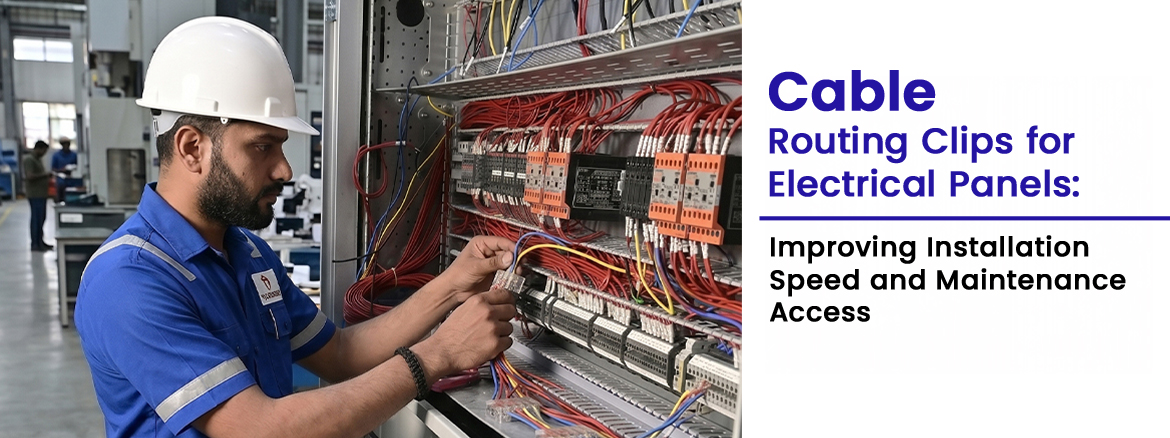
Consider a control panel containing more than 100 wires routed between terminals, relays and PLC modules. Without structured routing, tracing a single wire during troubleshooting may require moving multiple wire bundles. Properly placed cable clips help maintain organised routing paths and simplify maintenance activities.
Installation Rework in Panel Building: A Hidden Source of Time Loss
A significant portion of time in panel assembly is spent correcting wiring layout issues.
- Repositioning wires after initial placement
- Adjusting routing for accessibility
- Resolving congestion before final checks
In high-volume panel production, even small delays multiply across builds.
Poor wiring organisation increases rework time more than the initial installation time itself.
Cable Routing Clips in High-Density Panels: Improving Routing and Access
As panel density increases, wiring complexity grows.
High-density panels require:
- Defined cable routing inside panels
- Controlled spacing
- Clear access paths
Structured routing also reduces wire crossover, improving accessibility.
Defined routing paths also help maintain spacing between wires, improving accessibility during installation and maintenance.
In motor control centres and large automation panels, cable routing clips help maintain separation between wire groups, reducing congestion around terminals and making future modifications easier without disturbing adjacent wiring.
Choosing the Right Cable Routing Clips for Panel Layout Efficiency
Clip selection plays a practical role in installation and maintenance.
Consider:
- Compatibility with wire size and routing
- Mounting method
- Flexibility for future modifications
Different clip types used in electrical panels include:
- Push-mount clips for quick installation into pre-drilled panel openings
- Edge clips for routing wires along panel edges without additional fasteners
- Screw-mount clips, where a more permanent fixing method is required
- Adhesive-backed clips for applications where drilling is not preferred
- P-clips for secure cable retention and organised routing
- Plastic wire clips for general wire organisation inside panels
- Plastic cable clamps for managing multiple cables together in shared routing paths
Depending on routing requirements, products such as electrical wire holder clamps, edge clips and p-clips may be used to improve cable organisation inside panels.
The appropriate clip type depends on panel layout, wire density, accessibility requirements and maintenance considerations.
The right clip type ensures both assembly speed and long-term usability.
How to Evaluate a Cable Management Clips Supplier for Panel Applications?
Selecting a cable management clips supplier requires practical evaluation:
- Dimensional consistency
- Ease of installation
- Suitability for panel environments
The focus should remain on usability and consistency.
How Manufacturing Consistency Improves Installation Efficiency in Panel Wiring?
Novoflex has been manufacturing engineered components since 1980, with production facilities spanning 25,000 sq. ft. and a portfolio of over 1500 products.
For panel builders, this translates into:
- Consistent clip dimensions for predictable routing
- Stable product design requiring fewer adjustments
- Ready stock that supports uninterrupted production
Products are manufactured under ISO 9001:2015 certified systems and align with RoHS, CE and ZED Gold requirements. Products are also tested by recognised agencies such as UL and TUV Nord.
What This Means for Panel Builders and Electrical OEM Teams?
Using structured cable management improves:
- Assembly speed
- Maintenance accessibility
- Workflow efficiency
Efficiency in panel building is driven by structured wiring, not just skilled labour.
Why Cable Routing Clips Matter Beyond Basic Wire Fastening?
Cable routing clips are not just fastening components.
They enable:
- Organised wiring
- Better access
- Repeatable installations
In panel building, efficiency is defined by how easily wiring can be installed, accessed and maintained through structured cable routing.