Listen to this blog ...
Quick Answer
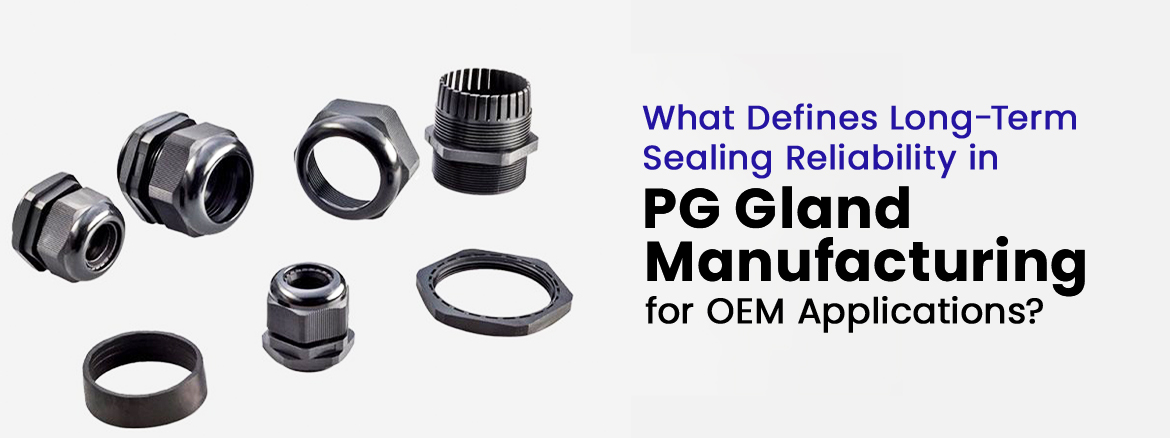
A reliable pg gland manufacturer consistently produces cable glands with repeatable dimensional accuracy, sealing performance and strain relief characteristics across production batches. For OEMs, long-term sealing reliability depends on manufacturing consistency, process control and performance under real operating conditions.
The Hidden Cost of Sealing Failure in OEM Electrical and Industrial Systems
In OEM production environments, sealing failure is rarely immediate. It develops under real operating conditions such as vibration, thermal cycling, mechanical load and environmental exposure.
A gland that performs correctly during installation can still lose sealing integrity after repeated thermal and mechanical cycles. These failures are not visible during initial inspection and often surface only after deployment.
Sealing-related issues are not always caused by product defects. They may result from installation variables, environmental exposure, operating conditions or interactions between multiple system components.
The impact typically follows:
- Enclosure integrity is compromised
- Maintenance intervention is required
- Production continuity is affected
- Lifecycle cost increases
Many of these issues are not detected during inspection. They emerge under sustained operating conditions where correction becomes more complex and costly.
Why PG Glands Are Critical for Cable Protection and Enclosure Integrity?
A pg gland is not simply a cable entry component. It acts as a control point for environmental isolation.
It performs three essential functions:
- Maintaining ingress protection
- Providing strain relief
- Supporting enclosure integrity
This makes it an important component for protection for cables in industrial cable entry systems.
Any sealing failure at this point can directly influence enclosure reliability and overall system performance.
Why IP Ratings and Specifications Do Not Guarantee Long-Term Sealing Performance?
Whether evaluating a cable gland designed for high ingress protection or an IP68 cable gland, specification compliance reflects performance under controlled testing conditions.
However, real-world environments introduce variables such as:
- Continuous vibration
- Repeated thermal expansion and contraction
- Prolonged exposure to moisture, UV and chemicals
A component that meets specification during approval may not maintain identical performance throughout its operational life.
In OEM environments, long-term sealing reliability is determined more by manufacturing consistency and operational behaviour than by initial specification compliance alone.
Evaluation must shift from:
“Does it meet the rating?”
to
“Will it maintain sealing performance after repeated operating cycles?”
How Material Selection Impacts Long-Term Sealing Reliability and Maintenance Cost?
Material behaviour plays a critical role in how sealing performance is sustained under real operating conditions.
Polyamide (Nylon)
Polyamide cable gland designs are widely used in industrial cable entry systems because they provide electrical insulation, corrosion resistance and a favourable balance between mechanical performance and weight.
These characteristics make them suitable for a wide range of electrical and industrial enclosure applications.
Under prolonged exposure to UV radiation, moisture and thermal cycling, material characteristics may gradually change, which can influence long-term sealing stability depending on application conditions.
Alternative Material Options
In applications requiring higher mechanical strength, elevated temperature resistance or exposure to harsh operating environments, alternative material categories may be considered depending on system requirements.
The key consideration is not simply initial compatibility but how the material performs across repeated operating cycles and environmental exposure.
Material choice influences:
- Maintenance frequency
- Replacement cycles
- Total cost of ownership
Material selection at the BOM stage can directly affect lifecycle performance and maintenance requirements.
Where PG Glands Are Commonly Used in Industrial and OEM Applications?
PG glands are used across a wide range of electrical and industrial systems where cable entry points require strain relief, enclosure integrity and environmental protection.
Electrical Control Panels
PG glands help secure cable entry points while supporting enclosure integrity in control panels used across manufacturing, utilities and infrastructure environments.
Electrical Enclosures
Electrical enclosures used in manufacturing, infrastructure and utility environments frequently rely on cable glands to support ingress protection, cable retention and enclosure integrity. Long-term sealing performance can influence maintenance requirements and system reliability over time.
Solar Installations
Solar systems are exposed to UV radiation, moisture and temperature fluctuations. Depending on environmental exposure and enclosure design requirements, higher ingress protection configurations such as IP68 cable glands may be considered to support cable entry protection in outdoor installations.
EV Charging Stations
EV charging infrastructure often operates in outdoor or semi-exposed environments where cable entry systems may experience weather exposure, vibration and repeated operating cycles.
Industrial Automation Systems
Industrial cable gland systems help support cable entry management, strain relief and enclosure protection in automation environments where reliability and operational continuity are important.
Telecommunications Equipment
Telecommunications cabinets and networking infrastructure frequently require protected cable entry points to help reduce exposure to moisture, dust and environmental contaminants.
Outdoor Enclosures
Outdoor electrical enclosures used in utilities, transportation and industrial facilities often require cable entry systems capable of maintaining sealing performance under changing environmental conditions.
Why Application Conditions Matter?
The long-term performance of a cable gland depends not only on the product itself but also on the operating environment.
Factors such as vibration, thermal cycling, moisture exposure and installation practices can influence sealing performance over time.
For OEMs and procurement teams, evaluating application conditions alongside product specifications supports more reliable enclosure integrity throughout the system lifecycle.
Where and Why PG Gland Sealing Fails in Real OEM Operating Conditions?
Sealing failure can often result from a combination of component performance, installation conditions and system-level operating stresses.
Gasket Compression Loss After Repeated Thermal Cycles
Sealing pressure reduces gradually under sustained load. After repeated thermal and mechanical cycles, this can lead to micro-leakage and reduced sealing effectiveness.
For example, in outdoor control panels exposed to direct sunlight, daily heating and cooling cycles can gradually reduce gasket compression force over time. As sealing pressure decreases, the risk of moisture ingress may increase depending on environmental conditions and system design.
This type of degradation often develops gradually and may not be visible during initial inspection or installation.
Vibration-Induced Thread Loosening in Dynamic Environments
Long-term vibration can reduce thread stability and weaken the sealing interface.
Thermal Expansion and Contraction Creating Micro-Gaps
Repeated expansion and contraction cycles may create small gaps that gradually reduce sealing effectiveness.
Environmental Degradation from Moisture, UV and Chemicals
Environmental exposure can influence sealing materials over time, with effects often becoming visible only after extended operation.
Installation Variability Across Assembly Lines
Under-torquing may reduce sealing pressure, while over-torquing can distort seal geometry. Across high-volume production environments, installation variability can become a scaling challenge.
These failure modes are rarely detected during initial inspection but may become significant under sustained operating conditions.
Tolerance Stack-Up in Cable Gland Systems: A Hidden Cause of Sealing Failure
Sealing performance depends on the interaction between multiple variables:
- Cable diameter variation
- Panel thickness variation
- Gland dimensional tolerance
Each variable may fall within the specification individually. However, cumulative variation can influence sealing integrity.
For example, acceptable variation in cable diameter, gland dimensions and enclosure wall thickness may individually comply with specification requirements. However, when combined, these variations can influence sealing effectiveness and installation consistency.
Sealing failure may result from combined variation across multiple components rather than a single defective part.
How Manufacturing Variation Affects Sealing Consistency in OEM Production?
Long-term sealing reliability depends heavily on manufacturing consistency across production batches.
Thread Accuracy and Dimensional Stability
Small dimensional variations can affect thread engagement and sealing compression.
Strain Relief Load Distribution and Cable Stability
Uneven clamping may create stress concentration points that influence sealing performance.
Installation Repeatability Under Real Conditions
A reliable pg gland should perform consistently even when installation conditions vary within acceptable production tolerances.
Long-term sealing reliability is a function of process stability across manufacturing cycles.
The key requirement is sealing repeatability rather than initial approval alone.
Batch Consistency in Cable Glands: The Biggest Risk for OEM Procurement Teams
Batch variation can introduce:
- Inconsistent fitment
- Assembly disruption
- Re-validation requirements
- Production delays
- Cost escalation
One inconsistent batch can create operational consequences far beyond the value of the component itself.
This is where procurement decisions move from product comparison to risk management.
Signs It May Be Time to Re-Evaluate a Cable Gland Supplier
Supplier performance is often assessed only when significant issues arise. However, smaller indicators may suggest the need for a closer review.
Examples include:
- Increasing assembly variation across production batches
- Repeated fitment inconsistencies
- Additional inspection requirements during assembly
- Dimensional differences between lots
- Limited traceability documentation
- Unclear quality control processes
For procurement teams, identifying these indicators early can help reduce production risk and avoid costly downstream validation challenges.
How to Evaluate a Cable Glands Manufacturer for OEM Applications?
Evaluating a cable glands manufacturer requires assessing manufacturing discipline rather than relying solely on specifications. OEM procurement teams often evaluate process control, batch traceability and dimensional consistency alongside technical specifications.
What to Ask
- How is dimensional consistency maintained across batches?
- Is batch traceability documented?
- How is sealing performance validated throughout production cycles?
What to Verify
- Consistency across production batches
- Evidence of process-controlled manufacturing
Indicators of Inconsistent Manufacturing or Supply Risk
- Variation across production lots
- Inconsistent fitment
- Lack of traceability
- Unclear installation guidelines
Why Long-Term Sealing Reliability Matters Beyond Initial Installation?
Many cable entry components perform adequately during installation and initial inspection.
However, OEM systems are expected to operate through years of vibration, thermal cycling and environmental exposure.
For engineering and procurement teams, the objective is not simply achieving sealing performance at commissioning. The objective is maintaining reliable performance throughout the operational lifecycle while minimising maintenance intervention, production disruption and total ownership cost.
How Manufacturing Discipline Supports Reliable PG Gland Performance?
For polyamide cable gland manufacturing, dimensional repeatability, thread accuracy and process stability directly influence sealing consistency across production batches. These factors often become important evaluation criteria for OEM procurement and engineering teams.
Novoflex has been manufacturing engineered plastic components since 1980, supported by a 25,000 sq. ft. manufacturing facility and a portfolio of over 1500 products.
As a cable glands manufacturer serving industrial and OEM environments, Novoflex focuses on process-controlled manufacturing practices designed to support repeatable production quality and dimensional consistency.
For OEM procurement teams, this translates into:
- Process-controlled manufacturing systems supporting dimensional consistency
- Batch traceability supporting audit-ready supply chains
- ISO 9001:2015, RoHS, CE and ZED Gold certifications
- Products tested by UL and TUV Nord
- Structured quality management practices
In industrial control systems and electrical enclosures, sealing inconsistencies at the gland level are often identified only after system validation, making them significantly more expensive to trace and correct.
What This Means for OEM Procurement and Engineering Teams?
Supplier selection directly influences:
- Long-term sealing reliability
- Assembly stability
- Maintenance exposure
- Warranty risk
- Operational continuity
Supplier evaluation is not simply a specification comparison.
It is a manufacturing process verification exercise.
Final Insight: What Truly Defines a Reliable PG Gland Manufacturer
Reliability is not defined solely by certifications or datasheet specifications.
It depends on:
- Process-controlled manufacturing
- Dimensional consistency across batches
- Material behaviour under operating conditions
- Repeatable performance across production cycles
Sealing reliability is not proven during approval testing alone.
It is sustained through manufacturing, installation and long-term operation.