Listen to this blog ...
One wrong choice of cable ties could cost you thousands in returns, repairs and lost customers.
In large-scale manufacturing and infrastructure development, the smallest components often carry the biggest responsibilities. Cable ties may be small, but a failure here can halt operations, damage equipment, or break compliance, turning minor parts into major liabilities.
Whether you’re managing production lines, sourcing for electrical systems, or building products for high-performance environments, choosing between polyamide (nylon) and stainless steel cable ties is a decision that impacts both performance and cost-efficiency.
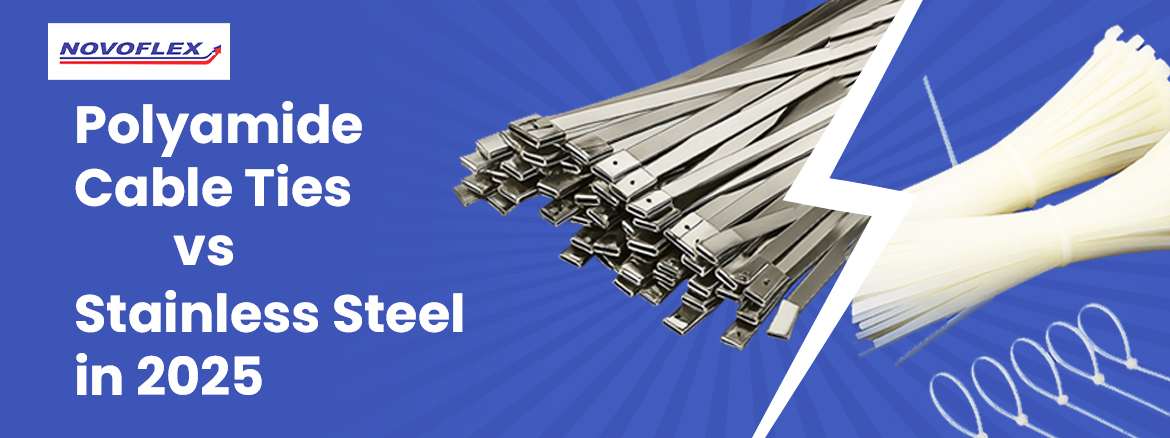
As a trusted cable ties manufacturer to India’s leading OEMs, we break down the core differences between polyamide (nylon) cable ties and stainless steel cable ties to help you stock smarter for 2025.
Why Cable Ties Aren’t Just Accessories
Cable ties are used in virtually every modern assembly from securing wire harnesses in automotive systems to managing cable loads in power stations. The wrong tie in the wrong place can lead to wear, breakage, or compliance issues, especially under heat, vibration, or corrosive exposure.
When production volumes are high or systems are critical, these ties must perform reliably, every time. That’s why choosing the cable tie sizes, tensile strength, and material resistance needs expert evaluation.
Why Polyamide Cable Ties Are the Smart Choice for Standard Electrical & OEM Applications
Recommended for: Indoor environments, electrical panels, appliances and control systems.
- Material: Polyamide 6.6 (Nylon)
- Temperature Range: -25°C to +85°C
- Cost Efficiency: Ideal for large-scale, budget-sensitive projects
- Ease of Use: Quick to install, compatible with automated systems
Nylon cable ties are a go-to for teams looking for fast, consistent, and scalable solutions, particularly where volume and flexibility are key.
Why Stainless Steel Cable Ties Are Ideal for Extreme Industrial Conditions
Recommended for: High temperatures, corrosive zones, outdoor installations, marine and industrial applications.
- Material: Stainless Steel
- Tensile Strength: Exceptional for high-load or vibration-prone conditions
- Temperature Resistance: Performs up to 538°C
- Corrosion Resistance: Resistant to chemicals, salt spray and harsh weather
- Durability: Ideal for mission-critical applications requiring long-term stability
Used widely in energy, defense and heavy manufacturing sectors, stainless cable ties provide unmatched strength and resilience where nylon would degrade.
From standard setups to extreme conditions, find the right cable tie for your application here.
Nylon vs. Stainless Steel Cable Ties: Quick Comparison
| Feature | Polyamide (Nylon) Cable Ties | Stainless Steel Cable Ties |
| Material | Nylon (PA 6.6) | Stainless Steel |
| Strength | Moderate | Very High |
| Temperature Tolerance | -25° C to +85° C | Up to 538°C |
| Corrosion Resistance | Moderate (UV grade improves it) | Excellent |
| Cost | Lower | Higher |
| Reusability | Single-use | Available in releasable options |
| Common Uses | Wiring, panels, appliances | Oil & Gas, Marine, Rail, Chemical Processing Plants |
| Sizes Available | Wide range of cable tie sizes | Based on industrial needs |
What Factors Matter Most in Choosing Cable Ties?
- Exposure: Will the product face UV rays, chemicals, or extreme heat?
- Load & Stress: Is the tie supporting cables, securing equipment, or resisting vibration?
- Installation Method: Is your setup automated or manual?
- Compliance Needs: Does your sector require specific safety or material certifications?
- Scale: Will you need bulk volumes or frequent restocking?
The right choice depends on how and where the tie will function. And for businesses where quality assurance and production timelines are tightly managed, this decision affects more than just cost.
Explore our full range of cable ties for every environment and load type.
Industry Applications of Polyamide and Stainless Steel Cable Ties
Different environments demand different levels of strength, heat resistance, and durability, which is why each cable tie type has its own set of ideal use cases.
Polyamide Cable Ties are commonly used in:
- Automotive OEM assembly lines
- Electrical and electronics manufacturing
- Consumer appliances
- Panel wiring and cable bundling
Stainless Steel Cable Ties are preferred in:
- Oil and gas refineries
- Railways and shipbuilding
- Power plants and heavy industrial units
- Harsh outdoor or high-temperature environments
Understanding the material-to-application match ensures long-term performance and reduces failures across installations, whether in day-to-day wiring or high-stakes industrial operations.
If you’re looking for high-performance fastening solutions that can handle everything from routine operations to the most demanding industrial environments, it’s clear why manufacturers choose solutions they know they can rely on.
That’s where Novoflex fits in, a trusted cable ties supplier delivering fastening solutions and trusted across industries to perform, last and never compromise
Why Novoflex?
- Four Decades of Expertise: A pioneer in the Indian manufacturing industry since 1980.
- Intricate Engineered Parts Manufacturing Expertise: Specialising in producing high-precision, complex components.
- Comprehensive Product Range: Over 500 products, including nylon cable ties, wire harness clips and polyamide cable glands.
- Stringent Quality Control: Adherence to internationally approved quality standards.
- Certified Excellence: ISO 9001:2008 Certified, RoHS, CE Marked, and ZED GOLD Certified.
- Tested by Renowned Agencies: Products regularly tested by UL, TUV Nord, and others.
- Industry-Specific Solutions: Catering to diverse sectors with tailored fastening and wiring accessories.
- Continuous Innovation: Driven by R&D to create cost-effective, versatile solutions.
- Customer-Centric: Prioritises understanding and fulfilling customer requirements.
- Ready Stocks and Efficient Delivery: Ensuring timely availability and swift delivery of products.
- Trusted by Industry Leaders: Proudly associated with top-tier clients like Maruti Suzuki, KIA Motors, Tata Motors, JCB, Escorts, Larsen & Toubro, ISRO, Schneider Electric, Nestle, Havells and more.
Conclusion
In 2025, smart sourcing starts with smarter choices. Whether it’s the versatility of polyamide or the unmatched durability of stainless cable ties, your cable tie selection directly affects performance, compliance and cost.