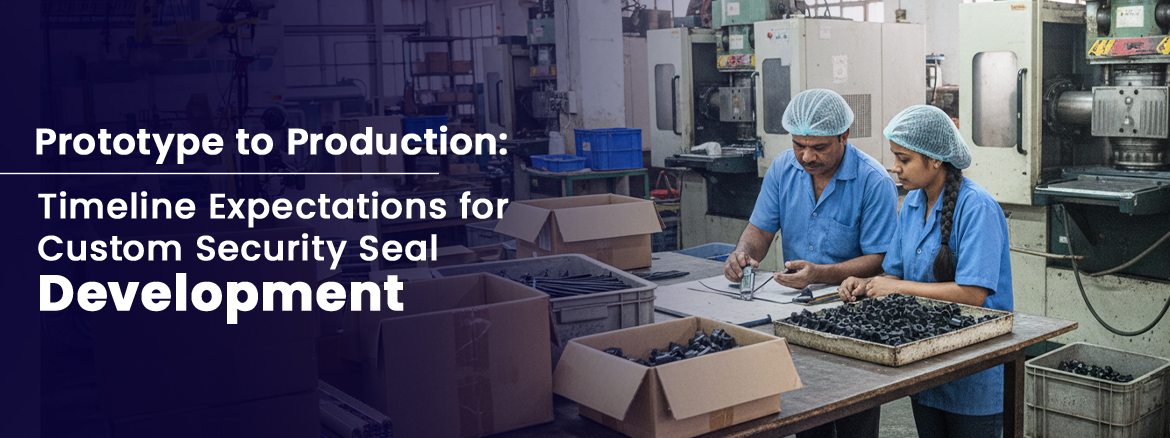
Listen to this blog ...
In industrial sealing applications, customisation is rarely optional. For OEMs operating in regulated logistics and export-driven supply chains, tamper-evident components must align with defined dimensional, serialisation and traceability requirements.
When evaluating a plastic security seals manufacturer, one of the most critical questions is not only capability but also timeline predictability. From prototype approval to bulk production, structured development stages determine whether it launches smoothly or encounters costly delays.
Understanding the lifecycle of custom security seal development helps procurement and engineering teams plan with greater clarity.
Why Custom Security Seal Development Requires Structured Planning?
Unlike standard catalogue components, custom tamper-evident solutions involve:
- Application-specific locking mechanisms
- Controlled break-force parameters
- Defined serialisation architecture
- Custom branding or identification markings
- Environmental performance verification
Each of these variables influences tooling design, injection moulding strategy and verification cycles.
A structured OEM component manufacturing process supports batch consistency and traceability once production scales.
Stage 1: Requirement Engineering and Design Verification (Typically 2–3 Weeks)
The development process begins with requirement mapping.
Key inputs include:
- Application environment (pharma, chemicals, automotive, logistics)
- Required tensile strength range
- Tamper-evidence visibility expectations
- Serialisation format (laser marking, hot stamping, barcoding)
- Volume projections
Stage 2: Tooling and Custom Mould Development (Typically 4–8 Weeks)
Tooling is the most time-sensitive phase in custom seal development.
This stage involves:
- Mould flow analysis
- Steel selection and cavity design
- Ejector and gating configuration
- Cooling channel optimisation
- Trial tool assembly
Manufacturers with established in-house precision mould design expertise and experience managing multi-cavity production environments bring greater process discipline and dimensional accuracy to custom security seal development.
Complex locking systems or multi-cavity tools may extend timelines.
Stage 3: Sampling, Functional Testing & Iteration (1–3 Weeks)
Once initial mould trials are completed, prototype samples are produced.
It typically includes:
- Break-force consistency testing
- Lock chamber integrity checks
- Dimensional tolerance verification
- Serial marking durability evaluation
- Environmental performance testing (humidity / cold storage if required)
While locking zip ties may be used for general bundling or packaging control, tamper-evident security seals require serialisation architecture and controlled break-force performance aligned with regulated logistics expectations.
In some cases, minor adjustments are required to optimise break-strength or marking clarity. Structured feedback loops prevent escalation into production delays.
Stage 4: Pre-Production and Process Verification
Before bulk rollout, manufacturers conduct controlled pre-production runs.
This phase shows:
- Batch consistency and traceability systems
- Serial number sequencing integrity
- Raw material lot tracking
- Production cycle stability
For OEMs requiring audit defensibility, documentation protocols are reviewed during this stage.
Production scalability must be verified before committing to large dispatch volumes.
During pre-production, security seals are evaluated not only for mechanical fit but also for serialisation feasibility, locking reliability and compatibility with regulated logistics workflows.
Stage 5: Bulk Production Scaling and Supply Continuity
Once tooling and process verification are completed, full-scale production begins.
Critical factors at this stage include:
- Stable cycle times
- Predictable material behaviour
- Serial governance system
- Quality control processes aligned with defined ISO frameworks
Similar production control systems are typically applied across engineered polymer products such as nylon tie wraps, where material stability and dimensional consistency directly influence high-volume performance reliability.
For long-term supply chain reliability, the transition from prototype to mass production must preserve the mechanical and visual characteristics approved during sampling.
This is where production stability and traceability discipline become critical.
Novoflex Recognition for Industry Outlook Magazine
Independent industry assessments have awarded Novoflex among the Top 10 Manufacturers in West Bengal (Industry Outlook Magazine), reflecting its structured production systems, engineering-led manufacturing approach and scalable infrastructure capabilities.
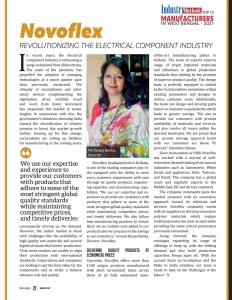
Novoflex was recognised by Industry Outlook Magazine among the Top 10 Manufacturers in West Bengal.
Common Factors That Delay Custom Security Seals
OEMs often underestimate the impact of:
- Incomplete technical specifications during the design briefing
- Late-stage serialisation changes
- Underestimated annual volume projections
- Tool modifications due to unclear locking tolerances
- Lack of structured testing protocols
What to Evaluate Before Selecting a Development Partner?
When selecting a partner for custom tamper-evident solutions, consider:
- In-house custom mould development capability
- Injection moulding capacity and machine range
- Experience in industrial sealing applications
- Serialisation system control
- Quality documentation structure
- Production scalability across high volumes
Manufacturers operating at scale across engineered fastening components often demonstrate broader tooling optimisation experience and high-output injection moulding discipline, capabilities directly relevant to security seals.
Novoflex’s standard commitment to Custom Security Seal Development
With over four decades of OEM component manufacturing experience, Novoflex structures custom security seal development through controlled engineering, tooling verification and documented production systems.
With export-oriented OEM manufacturing capability, Novoflex supports global security seal developments. The company integrates:
- In-house tooling coordination
- Injection moulding capability across engineered plastic components
- Serialisation architecture control
- Batch-level traceability systems
- Production scalability aligned with export-oriented supply chains
This structured lifecycle approach supports a predictable transition from prototype approval to production continuity.
Structuring Custom Seal for Scale From Prototype Approval to Production Certainty
A custom security seal manufacturer is not defined by speed alone. It is defined by engineering discipline, tooling precision and controlled production.
For OEMs, realistic timeline planning across design, mould development, sampling and scalability phases reduces disruption risk and strengthens long-term supply chain reliability.
A structured security seal partner does not simply deliver samples, it builds the process architecture required for predictable bulk production.
Engineering and procurement teams may review tooling feasibility, serialisation architecture and projected production timelines for their specific applications before development stages.
Connect with the Novoflex team for technical consultations and structured custom development assessment