Listen to this blog ...
Cable Management Has Become an Engineering Decision in EV Manufacturing
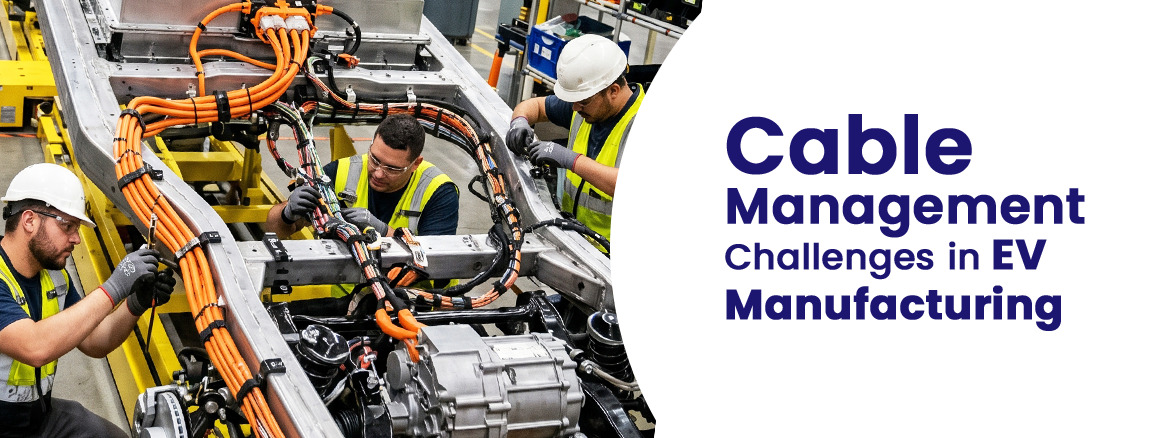
As EV electrical systems become denser, routing and securing cables within limited installation space has become a far more demanding engineering task. Battery packs, charging systems, power electronics and control units all require carefully planned cable paths that support efficient assembly while maintaining consistency throughout production.
The challenge is no longer limited to holding cables in place. Engineers must determine how cables enter an enclosure, how they are routed through compact assemblies and how those routing paths remain consistent across repeated manufacturing cycles. Decisions made during the design stage often influence installation efficiency, production consistency and future service accessibility.
Because of this, cable management is evaluated as part of the overall electrical system rather than as a collection of individual products. During supplier qualification, the operating requirements are established before cable management solutions are compared. While installation space, routing complexity and vibration all influence these discussions, temperature range frequently becomes the earliest engineering filter because it helps narrow the list of suitable components before more detailed technical evaluations begin.
Engineering Challenges That Influence Cable Management in EV Manufacturing
Every EV electrical assembly has its own installation requirements, but the engineering principles behind effective cable management remain consistent. Instead of evaluating temperature, routing or installation space independently, engineers evaluate these conditions together because cable management decisions are rarely based on a single design factor for a specific application.
1. Operating Temperature
Different areas within an EV operate under different environmental conditions. Battery enclosures, charging systems, power distribution units and electrical control assemblies may each present unique operating environments. During supplier qualification, engineers review whether cable management components are appropriate for the expected temperature range before progressing to broader technical evaluations.
Operating temperature is rarely assessed as an isolated specification. Instead, it serves as an early engineering filter that helps determine whether a cable management component is suitable before additional factors such as installation, routing and manufacturing requirements are reviewed.
2. Compact Installation Space
As electrical systems become more compact, more cable runs must be accommodated within the same installation space. This increases the importance of planned routing because cable paths, mounting locations and entry points all compete for limited space inside the assembly.
Well-planned routing layouts help simplify installation, reduce unnecessary congestion and support repeatable assembly practices during production.
3. Cable Routing Complexity
Modern EV electrical systems include multiple interconnected assemblies, making cable routing a design activity rather than an installation task. Routing decisions influence how easily assemblies can be built, inspected and serviced while helping installers reproduce consistent cable layouts throughout production.
Well-planned routing also reduces unnecessary cable crossings and supports a cleaner electrical layout, particularly where multiple cable bundles share the same installation space.
4. Continuous Vibration
During normal vehicle operation, electrical assemblies are exposed to ongoing movement and vibration. Because cable management components remain part of the assembly throughout their service life, engineers consider how cables will remain securely positioned under the intended operating conditions.
Temperature and vibration are often reviewed together because cable management components are selected for the complete operating environment rather than for individual conditions in isolation. Considering these factors together helps engineers compare solutions that better align with the application’s overall requirements.
Although installation space, routing complexity and vibration all influence cable management design, operating temperature often becomes the first engineering discussion because it helps engineers eliminate unsuitable options before progressing to detailed application or manufacturing evaluations.
Why Temperature Range Is Often the First Engineering Discussion
When manufacturers qualify suppliers for cable management components, they rarely begin by comparing product catalogues. The first objective is to determine whether a component aligns with the operating requirements of the intended application. Temperature range plays an important role in that initial assessment.
Different electrical assemblies within an EV operate under different conditions, so cable management components are assessed within the context of the specific application rather than selected using a one-size-fits-all approach. During supplier qualification, the expected operating conditions help narrow the range of suitable components before detailed engineering or manufacturing evaluations begin.
This early evaluation also influences the broader cable management strategy. Decisions related to cable entry, cable bundling and cable routing are connected rather than independent. Selecting one component without considering the overall system can create installation challenges later in the design or production process.
Operating temperature is considered alongside installation space, routing requirements and vibration exposure because these conditions collectively influence component selection. Assessing them together helps manufacturers compare cable management solutions that support the overall assembly instead of solving only one installation requirement.
Supplier qualification extends well beyond product availability. Manufacturers also evaluate whether recommended cable management components align with the application’s operating conditions and integrate effectively into the overall cable management strategy.
Selecting Cable Management Components for Challenging EV Environments
Effective cable management is achieved by considering how different components work together throughout the electrical assembly. Cable entry, cable bundling and cable routing each perform a specific role, yet together they create a structured system that supports efficient installation and repeatable manufacturing processes.
Managing Cable Entry
Every cable management system begins where cables enter an enclosure. Battery systems, charging equipment, power distribution units and electrical control cabinets all require planned cable entry that supports the routing strategy for the rest of the assembly.
Cable glands, including PG glands, are commonly used where cables pass through enclosure openings. During component selection, engineers review factors such as cable retention, strain relief and application-specific sealing requirements to determine whether a cable gland is appropriate for the installation.
Cable entry decisions made during the design stage often influence how the remaining cable routes are planned throughout the enclosure. Establishing cable entry early helps create a more organised routing strategy before production begins.
Supporting Structured Cable Bundling
Once cables enter the assembly, maintaining consistent cable bundles becomes the next priority. As cable density increases, securing cables in a planned manner helps installers follow defined routing paths and maintain repeatable assembly practices across production.
Flame retardant cable ties are widely used to secure cable bundles within electrical assemblies. Beyond fastening cables together, they help maintain planned cable layouts, reduce unnecessary cable movement during installation and support consistent routing throughout compact electrical systems. Consistent cable bundling also helps installers reproduce the same routing layout across repeated production cycles.
When engineering teams compare cable ties, they evaluate how the selected component aligns with the intended operating environment and the overall routing strategy instead of viewing it as an isolated fastening product.
Maintaining Planned Cable Routing
Creating organised cable bundles is only one part of an effective cable management system. Those bundles must also remain positioned according to the planned routing layout throughout the assembly.
Flame retardant cable tie mounts, including wire tie mounts and cable zip tie mounts, provide defined mounting points that help maintain consistent cable positioning within compact electrical installations. By establishing fixed routing locations, they support repeatable installation practices and contribute to more structured production workflows.
Together, cable glands, cable ties and cable tie mounts create a coordinated cable management system that supports cable entry, bundling and routing across the electrical assembly. Rather than selecting these components independently, engineering teams evaluate how they work together to meet the requirements of the intended application.
Beyond the Product: What Manufacturers Evaluate During Supplier Qualification
Selecting cable management components is only one part of the supplier qualification process. When evaluating cable tie suppliers, engineering and procurement teams also consider whether the supplier can consistently support manufacturing requirements, documentation and long-term production expectations.The objective is to minimise risk before a component becomes part of a production program.
Temperature range often becomes one of the earliest technical discussions because it helps establish whether a component aligns with the intended operating environment. Once that initial assessment is complete, qualification expands to include several additional considerations.
Application compatibility is one of the first areas engineers review. A cable management component should suit the intended installation rather than being selected solely because it is available or commonly used. Components are assessed in the context of the complete electrical assembly, ensuring they support the planned cable routing strategy.
Manufacturing consistency is equally important. During volume production, dimensional variation between batches can affect installation efficiency and assembly repeatability. Consistent manufacturing processes help engineering and production teams maintain standardised installation practices across multiple assemblies.
Technical documentation is another important part of supplier evaluation. Product information, drawings and relevant technical details allow engineering, procurement and quality teams to review the same information before approving a component. Clear documentation reduces uncertainty during supplier qualification and supports more consistent engineering decisions.
Production capability is another consideration that extends beyond the product itself. Manufacturers need confidence that suppliers can support ongoing production requirements while maintaining consistent quality across repeat orders. This becomes increasingly important for projects that involve long production cycles or multiple product variants.
Engineering support can also influence supplier selection. During the design phase, application-specific discussions help manufacturers compare cable management solutions before finalising component choices. Suppliers with practical application knowledge can support these evaluations by helping customers assess available options without replacing their engineering decisions.
Ultimately, supplier qualification evaluates more than individual components. It assesses whether the supplier can consistently support engineering requirements, manufacturing expectations and long-term production needs.
Why Manufacturing Experience Matters in Cable Management
Cable management components may represent a small portion of an electrical assembly, but their selection influences installation consistency throughout the manufacturing process. Choosing an experienced manufacturer provides confidence that products are supported by established manufacturing practices, quality systems and technical expertise.
Manufacturing experience often translates into greater consistency across product availability, production capability and technical support. These factors become increasingly important when projects require repeatable assembly processes and dependable supply throughout extended production programmes.
Since 1980, Novoflex has been manufacturing engineered plastic components for industrial applications. With a portfolio of more than 1,500 products, the company offers cable management solutions that include cable glands, flame retardant cable ties and flame retardant cable tie mounts for a wide range of industrial applications.
Alongside product development, Novoflex focuses on manufacturing consistency and application-driven cable management solutions that support customers across diverse industries. This combination of manufacturing experience and product breadth enables engineering teams to source multiple cable management components from a single manufacturer while maintaining consistency throughout their projects.
Conclusion
Cable management in EV manufacturing extends far beyond securing cables inside an electrical assembly. Increasing cable density, compact installation spaces, complex routing requirements and varying operating conditions require engineers to evaluate cable management as an integrated system rather than a collection of individual components.
While installation space, routing complexity and continuous vibration all influence component selection, temperature range often becomes one of the earliest discussions during supplier qualification because it helps determine whether cable management components align with the intended operating environment. From there, engineers assess how cable entry, cable bundling and cable routing work together to support efficient installation, repeatable manufacturing and application-specific requirements.
Effective cable management begins long before the first cable is installed. It starts during engineering, where operating conditions, routing strategy and manufacturing objectives are evaluated together to create electrical assemblies that remain consistent from prototype development through production.
Explore Novoflex Cable Management Solutions
Whether you’re developing electrical systems for EV manufacturing or other industrial applications, every project presents different routing, installation and operating requirements. Novoflex offers cable glands, flame-retardant cable ties and cable tie mounts designed to support structured cable management across a wide range of industrial applications. Contact our team to discuss the requirements of your application and explore suitable cable management solutions.