Listen to this blog ...
Quick Answer
Founded in Kolkata in 1980, Novoflex has evolved from manufacturing components for high-tension cable requirements into an Indian manufacturer of engineered plastic fastening and cable management components. Today, its portfolio spans cable ties, cable glands, automotive clips, PCB supports and other industrial components, with more than 1,500 products serving diverse manufacturing applications.
Introduction
In industrial manufacturing, a supplier’s history is useful when it explains present capability.
For OEM procurement and engineering teams, the relevant questions extend beyond when a company was established. They include how its product range developed, whether manufacturing infrastructure kept pace with changing requirements, how quality systems matured, and whether the supplier built experience across different application environments.
Novoflex’s development since 1980 reflects this progression. From cable-focused manufacturing in 1980, the company moved into cable ties, PCB supports, automotive harness clips, cable glands, security seals, stainless steel cable ties and other fastening and wiring components.

Our founder, Late TC Banka
Founder Vision
Founder Vision: Late T. C. Banka founded Novoflex in 1980 with a focus on quality products and services while keeping pace with developments in wiring accessories and the plastics sector.
1. From 1980 to Cable Ties: The Beginning
The early years established the manufacturing base from which Novoflex’s cable management range developed.
1980 — The Beginning
Novoflex was established in 1980 with an initial focus on high-tension cable requirements.
1984 — Introduction of Cable Ties
In 1984, Novoflex pioneered the introduction of cable ties to the Indian market.
Cable ties added a repeat-use fastening solution for bundling and organising wiring, establishing cable management as an important part of the company’s product development.
1990 — Larger Cable Management Requirements
By 1990, the range had expanded to include larger-diameter cable ties.
The expansion reflected the need to address a wider range of cable sizes within cable management applications.
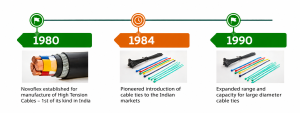
This early sequence established a pattern that continued through the company’s later development: the product range expanded as industrial fastening and wiring requirements became more varied.
2. Expanding Beyond Cable Ties
The product range moved beyond cable bundling during the 1990s.
In 1997, Novoflex expanded into PCB supports, circuit board spacers and cable ties/straps for different industrial applications. This brought the company into component positioning and support within electronic and industrial assemblies.
2001 — Cable Entry
In 2001, Novoflex expanded into cable glands, adding cable-entry components to its manufacturing range. The portfolio subsequently developed to include different cable gland configurations and application requirements.
2009 — Security Seals
In 2009, the company expanded into security seals, including tamper-proof security marking requirements.
This added tamper indication and identification to the existing fastening and wiring portfolio.
2012 — Stainless Steel Cable Ties
In 2012, Novoflex expanded into stainless steel cable ties, broadening the material options within its cable management range.
The development was part of a wider move toward components addressing different installation and application requirements.
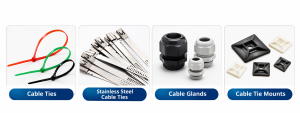
Today, Novoflex’s portfolio includes cable management, fastening, cable entry, PCB support, protection and security components.
CTA
Explore Novoflex’s cable management and fastening range
[ View Cable Management Products ]
3.Developing Components for Automotive Applications
Novoflex entered the automotive sector in 1998 and developed its first range of harness clips.
This widened the component requirements being addressed—from cable bundling into harness routing, panel fastening, trim attachment and electrical assembly support.
The automotive range subsequently developed across harness clips, cable clamps, fir tree mount clips, wire holders, grommet rings, cable tie mounts and edge clips, reflecting the wider fastening and routing requirements of vehicle assemblies.
The development continued with more specialised automotive clips, clamps and ties in 2015. In 2016, Novoflex also expanded into more specialised raw materials based on customer requirements.
The significance of this stage was the widening of application experience. Components were no longer being developed only around a product category; they increasingly had to address the requirements of specific assembly environments.
4. Manufacturing Capacity Grew Alongside the Product Range
A broader product range also requires manufacturing infrastructure capable of supporting repeat production.
Novoflex’s manufacturing development therefore progressed alongside its product expansion.
2002 — Automation
In 2002, Novoflex upgraded its facilities with fully automatic injection moulding machines.
2013 — New Manufacturing Facility
In 2013, production shifted to a new facility with a fully modernised setup.
2017 — Additional Production Capacity
A second fully modernised facility was expanded in 2017, increasing production capacity.
2023 — Further Expansion
Construction of a third facility began in 2023.
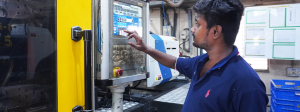
Today, Novoflex’s manufacturing infrastructure is approximately 25,000 sq. ft. in Kolkata, with capacity expansion ongoing. The company employs approximately 200 people and maintains a portfolio of more than 1,500 engineered components.
Why Manufacturing Capacity Matters to OEMs
For OEM programmes, manufacturing capability has to be considered beyond the first purchase order.
Production volumes can change, programmes can continue over extended periods, and approved components may need to be reproduced across multiple batches. This makes production capacity, process stability, tooling control, inspection and batch consistency relevant to supplier evaluation.
Novoflex identifies precision tooling and mould development, controlled production processes, process monitoring, quality inspection and batch-to-batch consistency among its manufacturing strengths.
For OEM supply, the objective is consistent reproduction of the approved component across production batches.
Discuss an engineered component requirement with Novoflex
 Talk to the Technical Team
5. Quality Systems Developed Alongside Manufacturing
Manufacturing expansion was accompanied by the development of more structured quality systems.
Key historical milestones include:
| Year | Milestone |
|---|---|
| 2010 | ISO 9001:2008 certification |
| 2014 | UL certification for the cable tie range |
| 2018 | IATF 16949:2016 certification |
| 2023 | ZED Gold certification |
Quality Through Disciplined Manufacturing

Quality is achieved through disciplined manufacturing rather than final inspection alone. Novoflex’s manufacturing quality philosophy places emphasis on production controls rather than final inspection alone.
These controls include:
- stable production processes
- repeatable manufacturing
- tool maintenance
- dimensional consistency
- process monitoring
- inspection procedures
- batch consistency checks
For repeat OEM production, these controls are relevant because quality needs to remain reproducible after initial product approval.
6. Building a Portfolio of 1,500+ Engineered Components
The cumulative result of this development is a portfolio of more than 1,500 engineered components.
The portfolio now covers several related assembly functions:
| Area | Representative Components | Typical Function |
|---|---|---|
| Cable Management | Cable Ties, Stainless Steel Cable Ties | Bundling and wiring organisation |
| Fastening | Cable Tie Mounts, Edge Clips, Wire Holders | Routing and securing assemblies |
| Cable Entry | Cable Glands | Cable entry and fastening |
| PCB Support | PCB Supports, Circuit Board Spacers | Positioning and supporting assemblies |
| Protection | Spiral Wrap, Grommet Rings | Wiring protection and organisation |
| Security | Plastic Security Seals | Tamper indication and identification |
The significance of the 1,500+ figure is therefore not simply the size of the catalogue. It reflects the breadth of component requirements Novoflex has accumulated around fastening, cable management, cable entry, wiring support and related industrial applications.
7. Supporting Different Industrial Requirements
Novoflex supports applications across automotive, electrical and electronics manufacturing, renewable energy, and industrial machinery and automation.
The company does not position these as separate product businesses. Many components perform similar functions across sectors, while material, installation method, environmental exposure and assembly requirements can vary.
For example, cable ties can support wiring organisation in automotive and industrial assemblies, while cable glands address cable-entry requirements in electrical equipment. PCB supports and circuit board spacers serve positioning and support functions within electronic assemblies.
This makes application context important when selecting an industrial component.
Novoflex’s product-selection approach considers factors including operating environment, installation method, material compatibility, environmental exposure, assembly process and long-term operational requirements.
The result is a portfolio designed to address different fastening, routing, entry and support requirements rather than a collection of unrelated products.
Recognition Along the Way
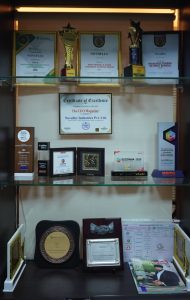
- Brand of the Year 2019 — Plastic Component Solutions
- Top 10 Manufacturers in West Bengal
- Top 10 Wire Harness & Cable Appliance Manufacturers 2025
- A+ supplier recognition from KOBELCO for three consecutive years
Novoflex Today
What began with high-tension cable requirements has developed into a broader manufacturing capability serving the component needs of modern industrial assemblies.
Today, Novoflex brings together 1,500+ engineered components, approximately 25,000 sq. ft. of manufacturing infrastructure in Kolkata, and an OEM-focused approach to production. Its range spans cable management, fastening, cable entry, wiring support and related industrial components, with capacity expansion continuing alongside the business.
The result is not simply a larger product catalogue, but a manufacturing base built to support varied component requirements and repeat OEM supply
Four Decades in Four Developments
| Development | How Novoflex changed |
|---|---|
| Product range | From an initial cable-focused base to 1,500+ engineered components |
| Application experience | Expanded into automotive and multiple industrial application environments |
| Manufacturing infrastructure | Progressed through automation, facility development and continuing capacity expansion |
| Quality systems | Developed from formal certification milestones into structured production and inspection controls |
Conclusion
Four decades of manufacturing are meaningful not simply because of the time involved, but because of what has been built through it.
Since 1980, Novoflex has evolved from its initial focus on high-tension cable requirements into an Indian component manufacturer with 1,500+ engineered components spanning cable management, fastening, cable entry, wiring support and related industrial applications.
That evolution has been accompanied by expanding manufacturing infrastructure, broader application experience and more structured quality systems, capabilities that continue to shape how Novoflex supports OEM requirements today.