Listen to this blog ...
Quick Answer
Cable management components pass through multiple handling stages before reaching assembly, including transport, warehousing and internal movement. Packaging systems that do not account for these repeated handling cycles frequently cause batch mixing, misidentification, component damage and operational delays.
Structured packaging standards help maintain component integrity, preserve batch clarity and support efficient movement across global OEM supply chains.
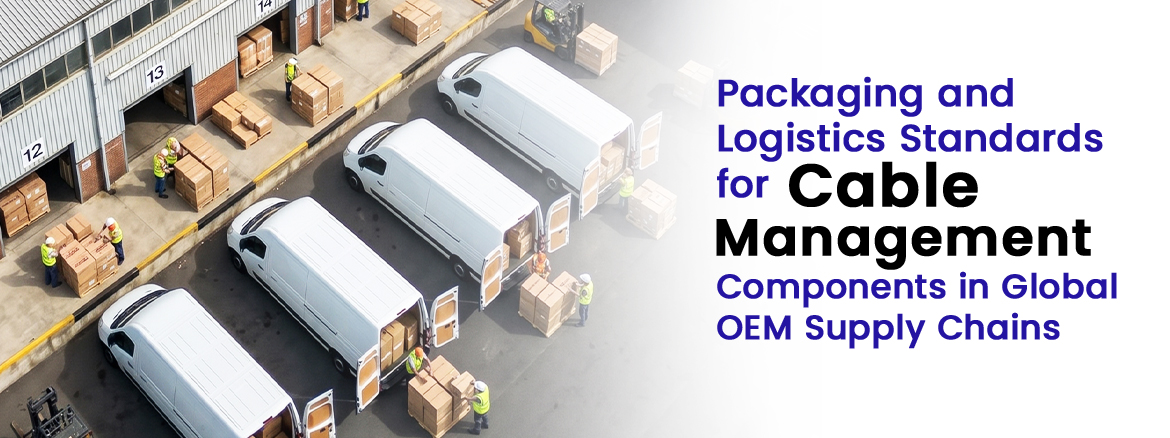
A cable tie may travel thousands of kilometres and pass through multiple warehouses, distribution centres and assembly locations before reaching an OEM production line. During this journey, packaging plays a critical role in preventing batch mixing, product damage and inventory errors.
For OEMs, packaging is no longer just a shipping requirement. It is part of supply chain performance.
1. What Happens to Components After Dispatch: Velocity vs Control?
Once components leave a manufacturing facility, they move through multiple handling stages before reaching the assembly line. These typically include loading, unloading, storage, internal transfers and line-side movement.
Each stage increases exposure to handling variation. As movement speed increases across global supply chains, maintaining control over component condition and identification becomes progressively more difficult.
This creates a fundamental challenge for OEMs:
Higher logistics velocity often reduces validation control unless packaging systems are specifically designed to compensate for it. Packaging becomes a key control mechanism in maintaining consistency across movement.
2. Batch Cohesion Failure: The Hidden Risk in Bulk Packaging
In high-volume shipments, components are commonly grouped in bulk packaging formats. While this improves transport efficiency, it introduces a critical risk: batch cohesion failure.
If even a small number of components from a different batch enter the same packaging unit due to poor segregation or handling, the entire batch becomes questionable from a traceability perspective.
For OEMs, this directly affects:
- batch-level traceability
- inspection scope
- operational verification
A small packaging inconsistency can expand validation requirements from a limited sample to an entire shipment, increasing time and operational effort.
3. Packaging Errors and the Cost of Micro-Stops in Operations
Packaging failures often appear not as visible damage but as operational friction.
Unclear or inconsistent labelling can interrupt warehouse scanning systems or inventory workflows. This results in micro-stops, repeated small pauses that reduce throughput without triggering major alerts.
These interruptions:
- slow down inventory movement
- increase manual intervention
- add hidden labour effort
Over time, these small inefficiencies accumulate and impact overall operational performance.
4. Optimising Volumetric Efficiency and Floor Utilisation
Packaging directly affects how efficiently space is used in logistics environments.
Over-sized packaging reduces pallet density and increases transport volume. Under-optimised formats waste valuable storage and line-side space.
For components such as cable ties, p clips and edge clips, packaging must balance:
- space efficiency
- accessibility
- stacking stability
In OEM environments where floor space is limited, inefficient packaging increases ongoing operational cost.
5. Handling Efficiency at the Assembly Line
Packaging influences how components are handled during assembly.
If packaging requires components to be transferred into secondary containers before use, it introduces an extra step known as line-side decanting.
This leads to:
- additional handling effort
- increased time per operation
- higher risk of mixing or loss
Efficient packaging allows direct movement from shipment to usage, reducing unnecessary handling.
6. Environmental Stability During Storage and Transit
Packaging must protect both the physical condition of components and their material behaviour during storage and transport.
For nylon-based components such as cable ties and plastic cable clamps, environmental conditions can influence:
- Moisture absorption
- Brittleness risk
- Flexibility retention
- Long-term material stability
For example, prolonged exposure to unsuitable storage conditions may affect how a component performs when it finally reaches the assembly line. This is why packaging systems are designed not only to prevent physical damage but also to support consistent material behaviour throughout storage and transit.
Environmental factors such as humidity, temperature variation and storage duration should therefore be considered as part of overall packaging and logistics planning.
7. Packaging Formats for Controlled Component Usage in OEM Systems
In many OEM environments, components are used in controlled quantities rather than taken from large bulk supplies.
When components are supplied only in large volumes, additional steps such as counting, sorting and redistribution are required before use. These steps increase handling time and introduce the risk of errors.
To reduce this, packaging is often structured into:
- master cartons for transport
- smaller sub-packs within cartons
- consistent quantity per unit
This allows components such as cable ties, wire connector clips and plastic cable clamps to be issued in predictable quantities without disrupting batch identification.
Structured packaging helps:
- reduce manual handling
- improve consistency
- maintain batch clarity
- support efficient inventory flow
8. Machine-Readable Identification in Logistics Systems
Modern supply chains rely on automated identification.
Packaging must support machine-readable systems such as:
- barcodes
- GS1 formats
- DataMatrix codes
These systems enable:
- faster processing
- accurate tracking
- reduced manual errors
If packaging does not align with automated systems, it creates delays and increases dependency on manual handling.
9. Logistics Containment: Limiting the Spread of Errors
When issues occur during transport, the ability to contain them quickly is critical.
Examples include:
- damaged packaging
- mixed components
- unclear batch identification
If these are not isolated early, they can spread through the inventory and affect production.
Effective packaging and labelling systems allow early detection and containment, reducing downstream impact.
10. Packaging Consistency Across Global Shipments
OEM supply chains operate across multiple regions and facilities.
Variations in packaging format or labelling across shipments can lead to:
- confusion in handling
- inventory mismatches
- delays in processing
Standardised packaging ensures consistency and reduces reliance on manual interpretation.
11. What OEM Teams Evaluate in Supplier Packaging Systems?
When evaluating a cable ties manufacturer or assessing a cable management clips supplier, packaging is reviewed as part of the overall supply chain capability.
Key factors include:
- consistency across shipments
- clarity of labelling
- batch separation
- ease of handling
- protection during transport
These determine how efficiently components integrate into OEM operations.
12. Logistics Efficiency as a Supplier Capability
Packaging reflects how well a supplier supports logistics operations.
Beyond manufacturing, suppliers are evaluated on their ability to enable:
- Efficient handling
- Organised storage
- Smooth inventory movement
In structured manufacturing environments such as Novoflex, logistics support extends beyond packaging alone and includes:
- Controlled manufacturing
- Structured batch traceability
- Consistent packaging formats
- Reliable shipment processes
- OEM-focused supply practices
Together, these practices help support consistent movement of components across warehousing, distribution and assembly operations.
13. Key Questions OEM Teams Should Ask About Packaging Systems
OEM teams should evaluate:
- How are components grouped and packed?
- How is batch identity maintained during transit?
- How are small components handled in bulk shipments?
- What consistency exists across shipments?
- How is damage risk controlled during transport?
These questions help assess real-world packaging effectiveness.
Conclusion: Packaging as a Core Logistics System
Packaging is not just protective, it is a functional part of the supply chain.
It influences:
- efficiency
- traceability
- operational consistency
For OEM teams, packaging should be evaluated as a core capability. Well-structured packaging reduces operational friction, supports consistency and improves overall supply chain performance.