Listen to this blog ...
Quick Answer
Small cable management components account for only a small fraction of an industrial project's cost, yet they play a significant role in cable routing, assembly efficiency, maintenance accessibility and long-term system reliability. For OEMs, these components are not simply installation accessories; they are essential elements of a dependable cable management system.
Why Small Cable Management Components Matter More Than Their Cost?
A wire tie mount may cost only a fraction of the components inside an electrical panel, yet it can influence how quickly technicians install, inspect and service that system for years.
For OEMs managing large-scale industrial projects, these seemingly small efficiencies can have a measurable impact when repeated across hundreds or thousands of installations. The same principle applies to many cable management components, whose relatively low cost can make them appear interchangeable during supplier evaluation.
Experienced procurement teams evaluate these components differently.
They recognise that while cable management components may not directly control the operation of a machine, they influence how effectively wiring is installed, organised and maintained throughout the equipment lifecycle. Components such as wire tie mounts, cable tie mounts, edge clips and circuit board spacers help maintain organised cable routing, reduce unnecessary cable movement and improve accessibility during inspection and servicing.
The value of these components often becomes more apparent after installation than during procurement.
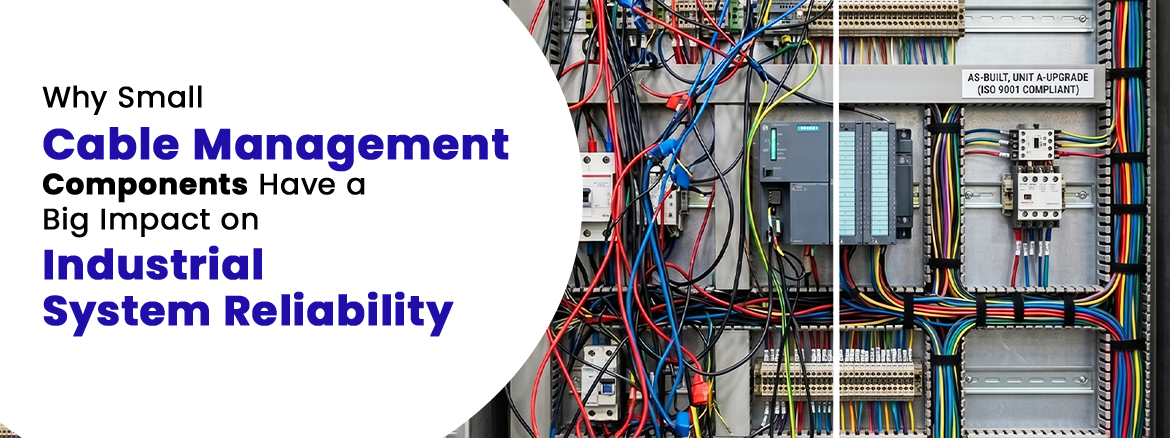
For example, consider an electrical control panel containing hundreds of wires routed between terminals, relays and PLC modules. If cable routing remains organised, technicians can quickly identify wiring paths during routine maintenance or future upgrades. If cable bundles gradually lose their organised layout, additional time may be required simply to access or trace the required circuits.
The electrical equipment itself may continue operating normally, but the additional effort required during routine servicing gradually reduces maintenance efficiency.
This highlights why experienced OEMs evaluate cable management components beyond their purchase price.
| Decision Based on Price | Decision Based on Lifecycle Value |
|---|---|
| Lowest purchase cost | Long-term system reliability |
| One-time cost saving | Maintenance accessibility over time |
| Basic installation requirement | Easier inspection and servicing |
| Product specifications only | Manufacturing capability and production consistency |
In many industrial systems, long-term serviceability is influenced not only by major equipment but also by the smaller components that support organised installation and maintenance. Every major component suddenly fails. More often, operational efficiency is affected by small changes that develop gradually over time, such as cable movement, reduced accessibility or additional effort during inspection and servicing.
For experienced OEMs, these are not isolated maintenance issues. They are factors that influence the overall performance and serviceability of the system throughout its operational life.
Why Product Specifications Alone Don’t Guarantee Assembly Line Consistency?
Selecting cable management components involves more than choosing products that fit the application. Experienced OEMs evaluate how those components work together to support organised installation, efficient servicing and consistent production across multiple projects.
A reliable cable management system depends on multiple components working together rather than individually. For example, wire tie mounts provide fixed anchoring points for cable ties, cable tie mounts help organise cable bundles, edge clips secure wiring along panel edges without additional drilling and circuit board spacers maintain the required separation between printed circuit boards.
Individually, each component performs a specific function. Together, they create organised cable routing that improves installation efficiency, simplifies servicing and supports consistent assembly across repeated production runs.
Selecting the right component type, however, is only one part of the decision.
During supplier evaluation, two products may appear almost identical in terms of dimensions, design or application. Yet appearance alone does not indicate how consistently those components will perform across repeated installation cycles, multiple production batches or years of industrial use.
For example, consider an OEM manufacturing electrical control panels for several infrastructure projects. If cable management components vary slightly between production batches, assembly teams may need to make repeated adjustments to achieve the same routing layout. While each adjustment may take only a few seconds, those additional efforts become significant when repeated across thousands of panels.
This is why procurement teams evaluate manufacturing capability alongside product specifications.
Reliable cable management begins long before a component reaches the assembly line. It begins with manufacturing processes designed to maintain consistent production quality over time.
Manufacturing capability plays an important role in determining whether approved components continue to perform consistently across future production batches. This is why experienced procurement teams evaluate supplier capability alongside product specifications rather than relying solely on initial product approval.
For procurement teams, this provides greater confidence that approved products can be supplied consistently throughout the life of a project.
Choosing the Right Manufacturing Partner for Long-Term Reliability
Selecting the right cable management component is only part of the procurement decision. The manufacturer’s ability to produce that component consistently over time is equally important.
Product design defines how a component is intended to perform, but manufacturing capability determines whether that level of performance can be maintained across every production batch. For OEMs managing large-scale projects or long-term production programmes, this helps reduce uncertainty during assembly, procurement and future supply planning.
Maintaining this level of production quality requires disciplined manufacturing processes.
At Novoflex, this includes injection moulding using multi-cavity moulds, periodic mould inspection and maintenance, production within specified ISO tolerances, process monitoring throughout manufacturing and batch-level quality verification.
Together, these practices help support repeatable production and provide greater confidence that future deliveries continue to match previously approved products.
As industrial projects become larger and more complex, procurement decisions extend beyond product specifications. OEMs increasingly evaluate suppliers on their manufacturing capability, ability to support bulk requirements, maintain consistent quality and ensure long-term supply continuity.
Although small cable management components represent only a small part of an industrial project’s overall cost, they contribute significantly to organised cable routing, repeatable installation and efficient servicing throughout the equipment lifecycle.
For experienced OEMs, selecting these components is not simply about securing cables. It is about choosing manufacturing partners capable of delivering dependable production, consistent quality and long-term supply reliability.
Whether you are approving a new supplier or reviewing existing sourcing decisions, evaluating manufacturing capability alongside product performance can help reduce production risk and support more reliable industrial projects.
Looking for Reliable Cable Management Components?
If you are evaluating cable management components for your next industrial project, look beyond product specifications.
Assess suppliers on their manufacturing capability, production consistency and ability to support repeatable quality across bulk industrial requirements. A structured manufacturing approach can help reduce production risk while supporting long-term project reliability.
With over 40 years of manufacturing experience and a portfolio of 1,500+ engineered plastic components, Novoflex supports OEMs with cable management solutions for industrial and infrastructure applications.